Golf rules can be difficult to understand, especially when a player faces an unusual situation on the course. Reading the official rulebook is useful, but it may not always be easy to find the right answer during a round. AI golf rules guidance offers another way to learn by helping recreational golfers explore specific situations, understand relevant rules, and make better-informed decisions.
1. Why learning golf rules can be challenging

1.1 Rules are not always easy to apply
Many recreational golfers know the basic rules of golf. However, problems often arise when a situation involves several details. A ball near a penalty area, for example, may raise questions about where the ball crossed the boundary and which relief options are available.
The correct procedure depends on the facts of the situation. Players may remember a rule incorrectly or rely on advice from playing partners who are unsure themselves. These misunderstandings can lead to unnecessary penalty strokes or incorrect procedures.
1.2 The rulebook does not always provide quick answers
The official Rules of Golf explain how the game should be played. However, finding the relevant rule and understanding how it applies can take time, particularly for beginners.
A golfer who is unfamiliar with terms such as abnormal course conditions or unplayable ball may struggle to connect the written rule with what is happening on the course. This creates a gap between knowing the rules in theory and applying them during a round.
2. How AI makes golf rules easier to understand
2.1 Asking questions in everyday language
One advantage of AI is that golfers can describe a situation in their own words. Instead of searching through several sections of a rulebook, they can ask a direct question about what happened.
For example, a player might ask what to do when a ball lands in a penalty area or becomes unplayable in a difficult position. An AI tool can explain the relevant rules and outline the options that may be available.
This approach can make learning more accessible to beginners. It also helps experienced recreational players review rules they do not encounter very often. However, the answer still depends on whether the golfer provides enough information for the situation to be understood correctly.
2.2 Understanding the reasoning behind a ruling
Learning a rule is more useful when players understand why it applies. AI can break an explanation into smaller steps and show how different facts affect the available options.
Consider a ball that comes to rest near a cart path. The player may need to determine whether the path qualifies as an obstruction and whether it interferes with the player’s stance or swing. If relief is available, the player must then follow the correct procedure.
An AI tool can help explain these questions in a clear sequence. Rather than memorising an answer to one situation, golfers can learn how to recognise similar situations in future rounds.

3. Learning through real on-course situations
3.1 Using images and follow-up questions
Some golf situations are difficult to explain with words alone. A photograph may help show where a ball lies, the type of ground around it, or its position relative to a course feature.
AI golf tools that support image input can use this information as part of their analysis. Follow-up questions can also help identify missing details. For instance, a player may need to clarify whether the ball is inside a penalty area or whether a nearby path is part of the course’s defined boundaries.
However, an image cannot always establish every fact needed for a ruling. Camera angles may hide important details, and a photograph may not show the exact boundary or the course’s applicable Local Rules. Players should provide additional context and verify important details when necessary.
3.2 Turning questions into future learning
A rules question can also become a learning opportunity after the round. Players can review an explanation, compare it with the official rules, and discuss the situation with other golfers.
Over time, reviewing real examples may help golfers recognise common mistakes and understand the choices available in different circumstances. This is especially useful for players who prefer practical examples to studying rules without a clear connection to the game.
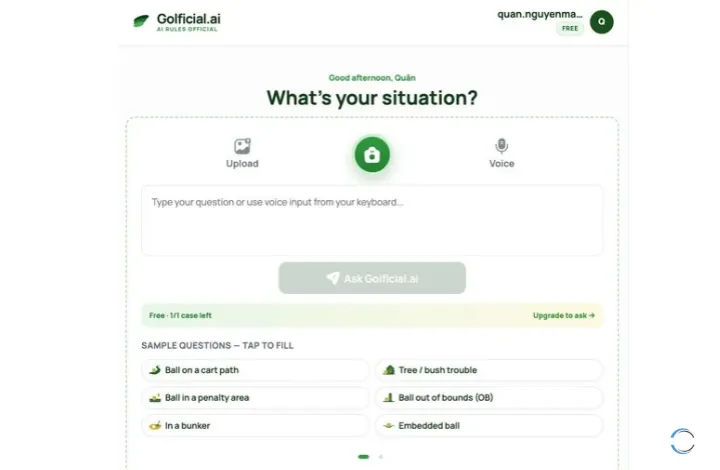
Platforms such as Golficial.ai support this approach by helping golfers explore rules questions and access guidance for on-course situations. Its community features also offer a way to engage with golf-related questions and shared experiences.
4. What AI cannot replace when learning golf rules
AI can make rules information easier to access, but golfers should not treat every answer as an official ruling. AI systems may misunderstand a question, miss an important detail, or provide an explanation that does not account for a particular Local Rule. For more reliable results, players should follow a few basic practices:
- Describe the situation clearly. Include the ball’s position, relevant course features, and what happened before asking the question.
- Check the source of the answer. Compare important guidance with the official Rules of Golf published by the R&A and USGA.
- Review the Local Rules. A course or competition may have applicable Local Rules that affect how a situation is handled.
- Ask an official when necessary. During a competition, players should follow the relevant competition procedures and seek help from a referee or the Committee when appropriate.
These steps are particularly important when a decision affects the score or the result of a competition. AI is best used as a learning and reference tool rather than a replacement for official rules or authorised decisions.

AI cannot replace local rules
5. A more practical way to learn the rules
AI is changing how recreational golfers access and understand golf rules. Instead of relying only on memory or searching through a rulebook, players can ask questions about real situations and receive explanations that help them understand the available options.
AI golf rules guidance is most useful when combined with accurate sources, clear descriptions, and a willingness to verify uncertain details. A platform such as Golficial.ai can support this process by connecting golfers with practical rules guidance and shared learning experiences. The aim is not simply to find an answer faster, but to help players understand the rules and apply them more confidently on the course.

Leave a Reply